


Work of Play - Learning Outdoors
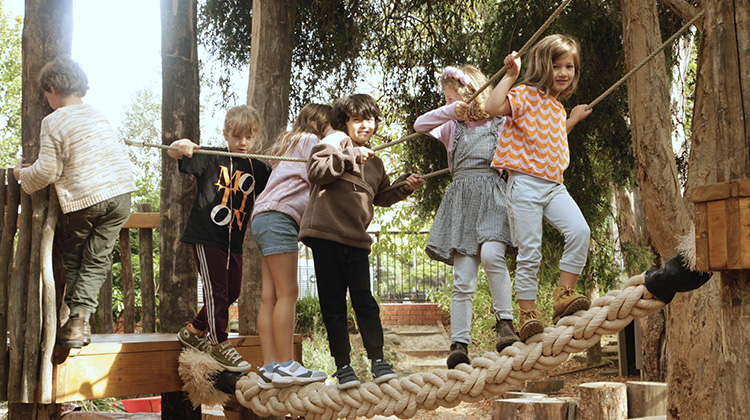
Making over an outdoor space to turn it into one that is designed for rich experiences and learning can be transformative to school environment, and when the children are involved in the project, brought in to contribute designs and observe the construction before being let loose in the area, the effect is maximized.
The biggest indicator of kids’ approval comes in the form of their play. The way they move, hesitate, balance, try. The conversations they have and the questions they ask verbally and non-verbally, directly and indirectly. The expressions on their faces, glee or concentration indicate they love outdoor learning spaces.
School absentee rates tend to improve. When students who have previously refused school choose to attend during a co-design or construction project or in the days and weeks that follow it speaks volumes.
Take Collingwood College’s, Melbourne, play space which was a well-loved and used area at the P-12 school.
Landscape architects Urban Discovery Collective were engaged to design and construct an upgrade to the site which would encourage and promote immersive play for students.
While maximising opportunities for play, the design considered the varying uses, users and needs for the space, mitigated site storm water and flooding issues, it’s Melbourne, and needed to be achievable within a restricted budget.
The team of education/pedagogy specialists went to work. They are Landscape Designers, First Nations guides and therapeutic and artistic practitioners who consulted with students and school leaders to develop the design which was achieved by the restoration of natural ecosystems on the site and the provision of habitat for play.
Jenn Reed, Founder, Urban Discovery, says, “We created diversity in the play types and elements suitable for the range of learners, swathes of planting were utilised to create ‘nooks’ and zones and previously unused steep areas of the site were activated through the inclusion of bespoke play elements.
“Existing infrastructure was repaired and refurbished wherever possible and learning decks created at the entrance to each classroom gave presence and identity, while also allowing for ease of flow and the integration of indoor and outdoor learning and regulation opportunities for students.
“The intentional location of elements has meant the play is varied and distributed and promotes whole body movement and experiential learning to occur spontaneously, as in the example of the collection and delivery systems of water the students have developed, whereby they pump water into a wheelbarrow, carefully travel along the foliage lined meandering pathway to the angled carved log on the western slope and collaboratively transfer the water from the barrow at the bottom to the channel at the top.
“Nature invites the children and teachers to immerse and create each day within the environment. The redevelopment from this perspective shifts the materiality of a traditional playground. Bringing natural materials to these spaces offer opportunity for exploration, experimentation and investigation. The restored ecosystem acts as not only a rich place for loose parts but furthermore to activate other framework and curriculum connections such as STEAM.”
Inclusions such as mud kitchens, water pumps, climbing, building, huts, loose parts, tinker boxes, creative investigation tables invite children to immerse themselves in the child's work of play.
One of the truths about any outdoor education site is that the land offers the greatest lessons a teacher could ask for.
Taking a class of students outside for lessons will present new opportunities for the students as well as for the teacher, however, the richest learning is experiential.
In one example, a group of preschoolers discovered the native blue-banded bee nesting in their completed play space. The children initiated their own project to protect the bees’ nests. They placed traffic cones around the nests and shared information with their community to ensure the safety of these bees.
The Urban Discovery Collective were engaged recently to design and construct a productive permaculture garden at St Francis of Assisi in Tarneit, Victoria, and worked with several grades each Tuesday for approximately six months.
Simone Myall, Indigenous Studies and Garden Specialist educator at St Francis of Assisi school reflects, “The students are no longer just 'gardening'; they are practicing phenology - learning to read the natural signs of the landscape to align our hands with the ancient rhythms.”
Reed says, “One grade 3 student was extremely keen to be part of the group. He wanted to learn lots, understand what we were doing in the farm and my story. Each week he would come to me look me straight in the eye and ask with huge curiosity ‘what can I do to help today, what can I do in the farm’. Whenever a child asked me this question, I would always divert their attention to the land. ‘What is the land telling us, what is the garden telling us, what can you see’ are questions I would pose.
“I noticed that although very keen to help, this boy had not left the safety of the concrete slab, just two metres from the door of the building. He would pivot and divert any task that I asked of him to ensure that he stayed on the concrete. Very quickly he became the photographer student that wrote the story, the student that designed the ideas and crafted the mission statement for the farm.
“Each week I would challenge him by asking him to do tasks or showing him something of interest in the garden away from the slab. He would stand on the slab and look really curiously, wanting to step off and fully engage in the garden.
“Some months after I left the farm I received a photograph from the teaching team of a smiling beaming child with a big bunch of carrots deep in the farm, nowhere near the concrete. I am still moved at this thought of this. We may never truly understand the power of this work.”
For most schools, constrained budgets and timelines are the norm. Natural habitats and nature rich play zones are cost efficient methods of developing play spaces and can often be supplemented with simple elements such as mud kitchens to further promote engagement.
Experiential learning projects, which centre on the restoration of the indigenous condition of the site, can be implemented to achieve project goals. These projects engage students and the wider community and activate a sense of purpose and belonging for everyone involved. They may be short projects, completed at a weekend working bee, or, long term projects which might cover all areas of the curriculum and be achieved over a series of many months or even years.
A long-term vision with short term goals enables projects to progress steadily. This type of project development allows all students, families, educators and the wider community to become involved and to develop relationships, strengthen networks, access resources and achieve collective success throughout each project milestone.
Reed says, “Community organisations such as local men’s sheds, land care groups, councils and businesses are great places to seek skills, supports and funding for staged projects, and we often work with clients to activate this type of community supported construction.
“Nature rich spaces evoke play in children and often in adults too. All of the key components for play (and consequently for learning) exist in diverse landscapes almost as if the earth herself is inviting us to connect. Much can be achieved with a constrained budget or timeline when we prioritise nature rich, immersive play spaces.”