


When a Plant Spoke of People
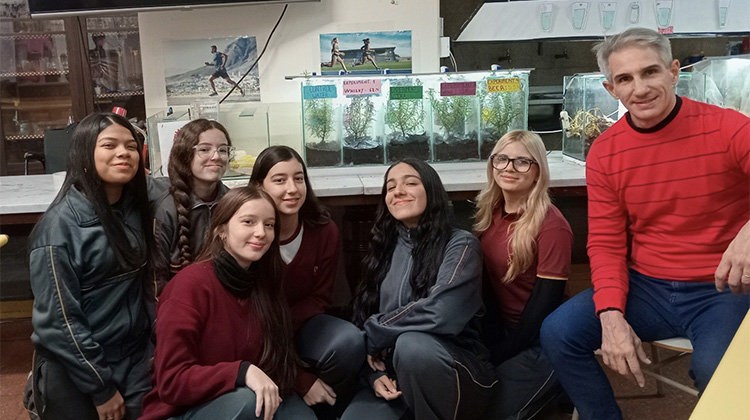
This paper describes a laboratory experience carried out with students aged 12 to 14, from seventh grade of primary school and first and second year of secondary school at Colegio Schonthal (in the Flores neighborhood of the Autonomous City of Buenos Aires, a school with a middle-to-upper socioeconomic profile), in which the effects of different alcohol concentrations (equivalent to beer, wine, whisky, and fernet) on rosemary plants were studied, using a control plant treated only with water. Beyond its biological value, the proposal sought to have students build their own process of observation, comparison, and hypothesis formulation through the application of scientific methodology. At the conclusion of the experiment, the interpretation of the results was used as a starting point for a collective reflection on the normalization of alcohol consumption among adolescents, without replacing scientific rigor with a moralizing discourse. The experience shows how an experimental design in Biology can become a pedagogical tool for developing critical thinking, integrating scientific knowledge with values education.
Theoretical Foundations
The best questions do not always arise inside a laboratory. Sometimes they appear in the most everyday places and, almost without meaning to, end up becoming the starting point of an educational experience.
This project began that way, standing in front of a supermarket shelf lined with alcoholic beverages. As I looked at that scene, a question came to mind that stayed with me for several days afterward, how could it be that alcohol consumption had become so normalized that it was now part of the weekend fun for so many adolescents?
The answer could not be found only in a theoretical explanation or a traditional lesson. As a Natural Sciences teacher, I felt the need to build a different kind of experience, a proposal in which scientific methodology itself would be capable of generating questions, sparking curiosity, and opening a space for reflection without abandoning the rigor of Biology. It was not about talking to students about alcohol, but about inviting them to discover, through an investigation they built themselves, how scientific observation can help us think through problems that are part of everyday reality.
The Design, in the Students' Hands
That question took concrete shape when the time came to plan ESI Week (Comprehensive Sexuality Education), the curricular period in Argentine schools devoted to addressing sexuality, addiction, and other issues relevant to adolescent life. It was there that I decided to carry out this project on alcohol consumption, using plants to explore how different concentrations, corresponding to specific beverages, could affect a living organism.
I told the students: "Let's design the experiment ourselves." From that point on, the project was entirely in their hands. The school provided a large glass tank, which the students divided into five independent compartments: one student brought small glass panels that he had cut together with his father at home, another brought silicone to seal them, and together they assembled the divisions. Another group of students brought soil, not purchased from a nursery, but gathered from their own home gardens, specifically so the experiment would include the natural biodiversity of real soil. Another group sourced the rosemary plants. One day we all gathered in the laboratory, around a large table with every material laid out, and the students built the entire experimental setup with their own hands, deciding for themselves how each compartment would be arranged. My role was to guide and refine their thinking, not to dictate their choices.
Once the setup was assembled, with all five plants healthy, we prepared the solutions corresponding to fernet (a bitter Italian liqueur, 45% alcohol by volume, which arrived in Argentina over a century ago through Italian immigration and remains deeply tied to our social life, typically drunk mixed with cola), whisky, beer, and wine, with a fifth plant receiving only water as a control. Using spray bottles, the students applied each solution directly to the soil, never to the leaves, covering it with plastic to prevent evaporation and thereby ensure that absorption occurred through the roots, in a deliberate parallel to the way alcohol is absorbed into the human body: not through the skin, but ingested and processed internally.
We chose rosemary for its suitable size and hardiness, sufficient to withstand several weeks of monitoring and to allow us to clearly observe the changes against the control plant.
From that point on, the laboratory stopped being just the place where Biology classes were held. Each session began with a routine that the students themselves gradually adopted as their own. They would prepare the spray bottles, carefully apply each solution to the experimental plants, and almost immediately come over to see whether anything had changed since the previous class. For the first few days, practically nothing was visible. And yet, far from fading, their curiosity kept growing. The question that came up again and again was always the same: Teacher, did anything change today?
That daily anticipation gradually transformed the dynamics of the laboratory. The students began going over each compartment of the tank with growing attentiveness. They compared the color of the leaves, noticed small variations, discussed possible explanations, and formulated hypotheses about what might happen over the following days. Without quite realizing it, they were absorbing one of the most important lessons of scientific work, understanding that knowledge does not appear all at once, but is built by observing, comparing, recording evidence, and waiting for the results to speak for themselves.
As the weeks went by, the plants treated with concentrations equivalent to whisky and fernet were the first to show clear signs of deterioration, followed shortly after by those treated with wine and beer, while the control plant remained green and healthy. None of us yet imagined that the most profound change in the experience would not take place in the plants, but in the way we would come to interpret them.
The Moment Everything Changed
Gathered around the tank to draw the conclusions of the trial, we found the contrast impossible to ignore, the plant watered only with water, green and firm, surrounded by the other four, completely destroyed. I asked them, "What happened to the plants?" They answered quickly, because they already knew: alcohol is a dehydrating agent, they said, one that destroys cell membranes, and it is also an oxidizing agent, one that breaks down organic matter into forms incompatible with life. It was a correct answer, a solid one, the kind any biologist would give.
I stayed quiet for a moment and looked at them, and they looked back at me, and then I told them: "No. That is not what happened to the plants. Do you know what really happened to them? They lost their friends, they stopped going to practice, their eyes look tired, they gave up on their studies, there is violence at home, they changed their physical appearance, they withdrew. That is what this trial is showing us: the destruction that alcohol causes in relationships, in families, in the way people behave."
Some of them lowered their eyes, others spoke quietly among themselves, and there were those who told me with complete sincerity, "It's true, teacher, now I'm thinking of it that way, what we're looking at is the destruction alcohol causes to a person's body and life."
From that moment on, those plants began to represent human situations present in our society: they were no longer just organisms affected by alcohol, they could also symbolize people who were gradually isolating themselves, losing connections, or seeing their physical and emotional health deteriorate. There was no attempt to replace the scientific explanation with a moral message, Biology continued to hold the central place in the experience. What changed was the scope of the learning.
From Biology to Symbol: Who Made the Leap
In the midst of the silence that followed, one of the students, staring fixedly at the tank, suddenly said, without anyone prompting him: "So, teacher, these plants are representing what happens to people when they drink too much alcohol." That line did not come from me, nor did I suggest it, it came from him entirely on his own, and from that moment on the rest of the group began to look at the tank as an image of what can happen to a person who loses control over their drinking.
The Closing: What Remained After the Silence
Several of his classmates agreed with him almost immediately, and I took advantage of that atmosphere to close the workshop, telling them that life is beautiful, meant to be enjoyed, to study, to grow, to move forward, to build good relationships with others, and that all of that can only be achieved through a healthy life, free from excessive alcohol consumption, which does so much harm to the brain and to life in general. When I finished speaking, a student sitting right in front of me began to applaud, and immediately the rest of the class joined in, almost without thinking about it, and I thanked them for that gesture with a smile and brought that day's workshop to a close.
Right away, three or four students came up and thanked me directly for the talk, telling me they had found it very interesting, that it had left them thinking about the behaviors many teenagers show when they get together on weekends, and about how other classmates they knew would end up in very poor physical shape the next day after drinking too much, with headaches, vomiting, and exhaustion, and they thanked me for the talk because it had helped them become more aware of what could happen to other friends of theirs who tend to drink large amounts of alcohol on weekends. Afterward, some of them began sharing their own stories, about nights out dancing, about seeing other teenagers drink large amounts of alcohol and change completely in how they behaved, becoming strange, absent friends, the kind you could no longer really talk to. And before leaving, one of them told me how great it would be if a friend of his, who did not attend this school, could hear that same talk, because it would surely help him a lot, since he was the one who truly needed it.
With that, my students left the laboratory. Days later, some of them came up to me in the school hallways to tell me they were still thinking about the talk, and about the need to live a healthier life, free from vices.In the days that followed, teachers, school administrators, and other students began approaching me, interested in learning how the project had come about and how the students had reacted. Little by little, the experience stopped belonging only to the laboratory and became a topic of conversation throughout the school community.
Over time it became clear that the most important result of this work was never inside the tank. The real result was confirming that an experience built on scientific methodology can become a powerful pedagogical tool for fostering observation, critical thinking, and reflection, without abandoning scientific rigor. Teaching Natural Sciences is not only about explaining how the biological world works; it also means creating situations in which that knowledge helps us better understand the world we live in, shaping citizens capable of observing reality with a more critical, conscious, and deeply human outlook.
References
Observatorio de Adicciones y Consumos Problemáticos, Defensoría del Pueblo de la Provincia de Buenos Aires. (2024). Informe sobre prevalencia de consumo de alcohol en adolescentes escolarizados. https://www.defensorba.org.ar
Organización Mundial de la Salud, & Ministerio de Salud de la Nación Argentina. (2018). Encuesta Mundial de Salud Escolar (EMSE), 3rd ed. WHO.
Parra-Coronado, A., Fischer, G., & Chaves-Córdoba, B. (2015). Respuesta de las plantas al estrés por déficit hídrico. Revista Colombiana de Ciencias Hortícolas, 3(1). http://www.scielo.org.co/scielo.php?script=sci_arttext&pid=S0120-99652009000200006
Tetteh-Quarshie, S., & Risher, M. L. (2023). Adolescent brain maturation and the neuropathological effects of binge drinking: A critical review. Frontiers in Neuroscience, 16, 1040049. https://doi.org/10.3389/fnins.2022.1040049
Walker, C. D., Sexton, H. G., Hyde, J., Greene, B., & Risher, M. L. (2022). Diverging effects of adolescent ethanol exposure on tripartite synaptic development across prefrontal cortex subregions. Cells, 11(19), 3111. https://doi.org/10.3390/cells11193111
National Institute on Alcohol Abuse and Alcoholism. (2023). Alcohol and the adolescent brain. U.S. Department of Health and Human Services. https://www.niaaa.nih.gov/publications/alcohol-and-adolescent-brain
Cho, M. K., & Cho, Y. H. (2021). Do alcohol prevention programs influence adolescents' drinking behaviors? A systematic review and meta-analysis. International Journal of Environmental Research and Public Health, 18(16), 8524. https://doi.org/10.3390/ijerph18168524
Sebastian Alberto Chiapella is an Argentinian teacher of Biology, Physics, and Chemistry, and a graduate of the Instituto Superior del Profesorado "Joaquín V. González" (Buenos Aires, Argentina). With 27 years of teaching experience, he has worked with students at all levels, including adult learners. He specializes in laboratory work, where he designs experiments with his students aimed at testing scientific hypotheses, always seeking a connection to real world issues grounded in respect for both nature and the individual. He currently teaches at Schönthal School, La Candelaria School, and Cárdenas School and also worked as a student tutor and as head of the Biology department at one of the institutions where he teaches.