


The Enigma that is the New Zealand Education System

Just in case Australians are unaware - New Zealand (NZ) is a relatively small country to the East of Australia by approximately 1600km. A small number of people have kayaked that distance, although none have swum. NZ has approximately 20% of Australia’s population. Australia’s current per capita GDP is around US$65k while New Zealand’s is about 33% below that. NZers like to talk about being 3rd in the world for GDP in 1950 but also like to forget that it was 76 years ago and that Europe had next to no food production at the time. NZ now ranks 36th in the world for purchasing power of GDP. In terms of productivity New Zealand is 30% below the OECD average.
Australia has snakes, spiders, sharks, cane toads, Aussie Rules and other things people in NZ cannot comprehend. NZ has flightless birds and sheep. At present approximately 40,000 New Zealanders go to Australia, to live, each year. NZ is getting incrementally closer to a “last one out - switch off the lights” scenario.
New Zealanders like to think that they “punch above their weight”. Given the 34% of our adults and 13% of our children are officially obese - that is quite a claim. We certainly have some good sports people in relatively minor sports but we have only had six football players in the EPL, four in the NBA, none in the MLB, and none in the NHL. Our cricket team has truly had some remarkable results and, as rugby grows as an international sport, NZ is still competing.
NZ’s military is not very big but maybe distance provides a good level of protection. In the 1980s people in kayaks challenged nuclear capable US warships.
My field is education and this is one of NZ’s greatest long-term disasters. In terms of a parallel to the GDP situation - people in NZ like to note that in the 1970s the country was “world leading” for education. It is clearly no longer the case and the reasons for past success are far more about social alignment than teaching practice/school quality. In terms of the most credible comparison (PISA) NZ is now 23rd in the world for Maths, 12th for writing and 10th for reading - and heading in only one direction. In terms of other international studies (e.g. PIRLS) New Zealand is well below the OECD averages.
According to PISA, where NZ excels is in the largest gaps between the highest achievers (significantly aligned to wealth and ethnicity) and the lowest. NZ also leads the world for bullying.
NZ only has 460 high schools. None of them has to have achievement aims - short or long term. In terms of the top broad school qualification, University Entrance (UE), for the top 50 schools in the nation (almost all private or pseudo private) 86% of their leavers have UE. For the bottom 50 schools it is 4.7%.
NZ education statistics are not just appalling with regard to wealth. For ethnicity 61% of Asian students leave school with UE, 43% of European, 24% of Pasifika and 19% of Maori. Girls also exceed boys by significant margins.
NZ has many issues to tackle in terms of education. One is the political malaise. Of the last 18 years 12 have been National Party led and 6 Labour Party led. National typically makes a lot of noise but fundamentally change very little. The current government has typified that. They also create large divisions and govern for the middle/upper class. Labour are far more passive and aligned with unions - but bring about no improvements for anyone. The swings are akin to the skinniest imaginable pendulum - while results continue to decline. For 2025 leavers of the NZ education system 19% (13,165 individuals) had no qualification at all - after 13,200 hours of funded schooling. NZ also has an extraordinary number of 18-24 years olds as NEETS (not in Employment, Education or Training).
I write from within the NZ education system as a long term educator, principal and researcher/writer. Recently I was directly asked: “What would you do?”
I was a child of a low income and significantly problematic childhood. I had a solo mother who was born in 1934, into a family with 11 siblings. I was a survivor or a very low-quality high school. I have a Bachelor of Business Studies, a teaching diploma, a Master's in Education and a post graduate diploma in sports management. I was a teacher, Head of Department, and Sports Coach at three major NZ high schools. I then founded a small private school and led it for 20 years. On the back of that I founded and advised two Charter Schools from 2014 until 2021. Every year I research and publish the leavers' data of every high school in NZ. As a sport coach my best achievement has been to contribute to the development of 18 players who have competed in rugby world cups. I am a parent of three children who are qualified at a tertiary level with two at degree level and one at PhD - with each involved in remarkable careers.
The first point on how to improve all things education in NZ is that, so long as any government think that they are the podium of truth in this area - they will fail and all improvements will be marginal (at best). The following are 16 suggestions.
1. NZ desperately needs a Crown Entity for Parenting.
It needs to be non-interventional and free from political influence and to promote through the broadest means, the very best developmental science/practices for children from conception to five years old.
It has to have the aim of NZ becoming the world’s best nation for parenting.
Parenting is clearly more important than schooling for education success. Good schools help but it is parents that do the hard yards. At present the perception is that good parenting is strongly correlated with wealth. This pattern/perception needs to be broken.
The actual practices in the crucial first five years do not need lots of money;
- Good basic nutrition.
- Good shelter and clothing.
- Parents free of drugs and alcohol - from conception.
- MANY words being spoken every day. And positive words.
- Eating together.
- Minimalising screen time and maximizing activity and human contact.
- Parents reading to their children EVERY night.
- Music in the home.
- etc
2. The Ministry of Education needs to be completely re-structured and re-purposed.
The influence, incompetence and shear absorption of taxpayer funding of the Ministry of Education has to be significantly diminished. The current government promised, pre-election, to reduce the size of the bloated education bureaucracy from over 4,000 employees to 2,700. It hasn’t happened and is a broken promise worth $295m per annum. NZ’s Ministry of Education is one of the great examples of David Graeber’s BS jobs, and all manner of studies into bureaucratic behaviour, where you employ more people and see a HUGE decline in performance.
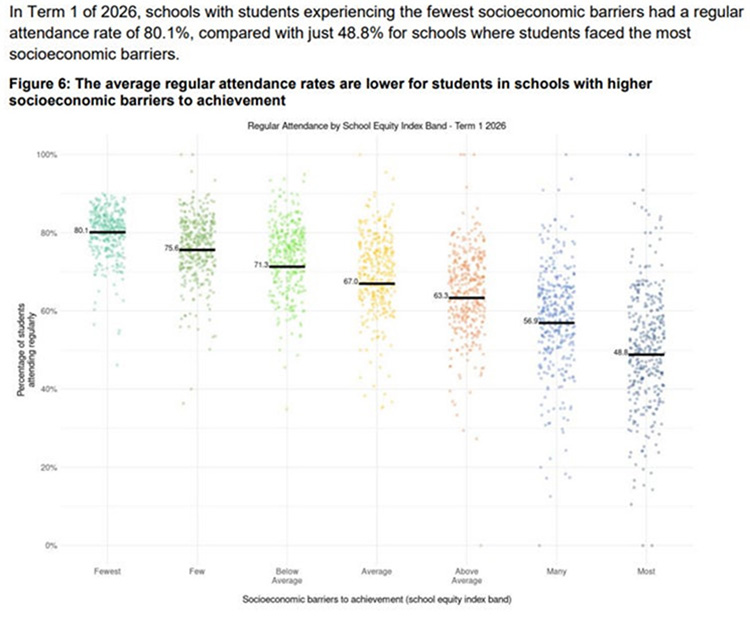
3. Attendance must be dramatically improved - especially for the lower socio-economic levels, Maori and Pasifika.
4. NZ’s Differential Funding needs to be reviewed.
NZ has something called the Equity Index (EQI) to, theoretically, provide extra funding for schools with more “at risk” students.
Equity Index funding in 2024 was less than $250 million in total against direct spending of $7.9 billion. For challenged schools is around 3 per cent of operational and teachers pay funding, yet it is one of the mechanisms we are trying to level the playing field.
The differentials are simply WAY too small to make a significant difference.
5. The human aspect of education needs to be advanced.
The current government is hyper-focussed on workbooks and phonics and they make much less difference than the public is being told. The things that do are; school leadership, very clear and aspirational programmes to increase teacher quality and retention. Very few students remember a great facility or workbook- but they will tell you about their great teachers.
6. A great Designated Character School model would be significantly better than Charter Schools.
NZ has a Charter School policy. It is a complete bust with tiny schools and just 0.2% of NZ students attending them after nine years of effort. No State Schools have converted - including none of the former Charter Schools (2014-2017).
What is needed is a fully open Designated Character School policy that takes care of property and does not limit attending numbers. Given the nature and needs of the NZ system this is a better development pathway for new and innovative schools.
7. NZ should significantly enhance the Private School system.
Any reading of our school leavers data shows that private and designated character schools dominate the top level.
In Australia 36% of children attend private schools with a government subsidy of $14,000 per student.
In NZ 3.6% of children attend private schools with a government subsidy of $1,400 per student. That amount is then lost to schools as NZ is one of only two OECD countries that charge GST/VAT of school fees.
Private schools save the government a fortune for every student and the savings could be used to enhance state schools.
8. The current government has attempted to re-write the full NZ curriculum. The writing process has to be immediately and fully reviewed.
There is a strong sense in the sector that subject experts have been ignored and that the consultation process is farcical. This should be acknowledged and genuine engagement with the sector established.
There is also concern that almost all resource publishing contracts are going overseas.
9. NZ should consider mandating the Cambridge exams and upper school curriculum - with NZ aspects in subjects such as History.
NZ is truly in danger of creating 12 years of chaos in education through curriculum and qualifications changes with a Minister captured by a very small group of ideologues.
It would be much cheaper, simpler, internationally comparable - and easier to implement - to simply mandate the Cambridge exams and upper school curriculum.
10. A great deal more needs to be done for the children in the middle of these changes.
As detailed above; in 2024 15.9% students left NZ’s school system with no qualifications. This was a decade high. The 2025 leavers data showed 18.59 students leaving without a qualification. The impact on those students - and society as a whole - is massive and a great deal could have been by Minister Stanford to change those outcomes.
11. The NZ government needs to fully and effectively re-engage with Maori and Pasifika re Education.
There is a very powerful perception that the current government is, at best, negligent of the interests of Maori and Pasifika communities. A cabinet paper also states that the new qualifications system will, at least in the short term, negatively impact results for marginalized groups.
12. Enhancing being LITERATE above functional literacy.
While there is some, very limited, data that appears to show the change to “Structured Literacy” is having a positive impact for children, I see three significant issues.
One is that the lack of full attendance for marginalized groups means that they have very little chance of improving - regardless of the programme.
Two is that some children are already bored witless - especially those who start school already able to read. Right through an education system children need to be inspired by great books and adults passionate about literature. Functional literacy and being genuinely literate are worlds apart.
Three is that talking about “the Science of Reading” risks further sidelining parents. Prior to the last NZ election I attended a Literacy Conference in Wellington. At the end I asked the panel how they saw the role of parents in the proposed changes. To a person, the panel told us that they considered parents too busy to help and that the complexity of the process would be a barrier.
13. School lunches, if done, need to be done well.
NZ has a school lunch programme for “the poor”. The current government has reduced the spend to $3 per meal and what is provided resembles what a cat leaves behind after over-eating.
NZ needs to spend more money and make the meals superb. Let the children know that they are valued. Give them another reason to get out of bed and go to school. Once a week it should be a shared lunch with parents. It will still be a tiny portion of the education spend of $7.5b.
14. Be very smart with device use and AI.
NZ needs to develop a genuinely expert research group to accurately evaluate and report on the best use of technology and AI in our schools.
Like many countries devices have been over-used and all applications need a review.
With AI there are two major risks. Over implementing/applying without clear research. Going too slow and being left behind the world.
15. Have a strong emphasis on creativity, problem solving and entrepreneurship.
Much of the current emphasis is on the basics and also, through the push for vocational education, providing labour for industry and tradies to service NZ homes.
With the appalling productivity measures NZ is desperate for a generation of exciting innovators and risk takers.
 16. Much work needs to occur to generate a greater understanding of neuro-science that will allow children to be seen with fewer limits.
The idea of fixed levels of abilities is long gone but many schools and teachers act as if an accurate understanding of “intelligence” for a range of reasons - none of them good.
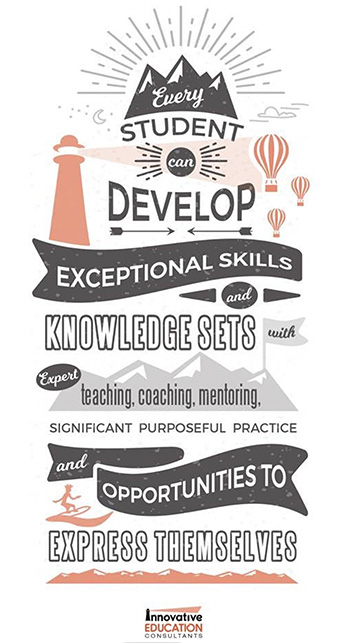
NZ has to return to having ideals. A current goal is that, by 2030, just 80% of Year 8s will be literate. It is appalling. Every teacher should teach on the basis that every child in front of them is remarkable and can do remarkable things. My learning statement is in the infographic (left).
I am doing my best to contribute and am currently in the process of establishing two new private schools in central Auckland where there is significant need/opportunity. I would welcome hearing from education and investment partners.