


Making Sense of the 2026 Aggregated NAPLAN Data 2026: Reflecting Back and Looking Forward

The national report card on Australian students’ literacy and numeracy skills is in for 2026. On August 5th, the aggregated results for Australian students’ (tested at Years 3, 5, 7, and 9) performance on literacy and numeracy measures were released by the Australian Curriculum, Assessment and Reporting Authority (ACARA). There is always great interest in these data, particularly by educational policymakers and sections of the media. However, the headline for 2026 could be summarised as “same same”. That is, across the various parameters assessed via NAPLAN (reading comprehension, writing, conventions of language and numeracy), there is, on average, a persistent, and frankly, unacceptable one-third of Australian students not meeting proficiency standards (1). It’s been the same story for some years now (2). Australia cannot move forward as a thriving nation if one in three students continue to exit school lacking proficiency in reading, writing and numeracy. Individuals with poor reading proficiency and low numeracy skills face elevated risks across multiple domains of life, including educational and vocational participation, employment and earnings, health and wellbeing, and psychological outcomes (see here, here and here).
The picture is alarming when we dig behind the overall “one-in-three” figure and explore proficiency levels by demographic subgroups. Take both reading and numeracy proficiency at Year 3 for example: just over 32% of students, as a whole, fell into the lower two bands for reading, and 35.9% for numeracy However, this rises sharply for students in remote areas: almost 56% for reading, and 56.9% for numeracy. In very remote areas, it climbs further still: 76% for reading, and 56.9% for numeracy. Among Indigenous students, 61% fell into the lower two bands for reading, and over one in three for numeracy. The trend is similar for Year 9 students. On average, 36% of students were in the lower two bands for reading, rising to 59% (remote), 77% (very remote), and 67% (Indigenous). For numeracy, 11% needed additional support overall. This rose to 53.4% for Very remote students and 34.7% for Indigenous students.
Age and time at school does not alleviate poor proficiency. This is an established fact, certainly in the literacy domain, identified back in 2005 by Spira and colleagues who, based in their longitudinal study, reported that early reading difficulty was relatively persistent, with 70% of struggling year 1 readers still struggling at Year 4. Similarly, for numeracy, Jordan and colleagues (2009), in a longitudinal study tracking children from kindergarten to Grade 3, found that early number competence was a strong and stable predictor of later mathematics outcomes. More recently, in the Australian context, Williams and Groves (2023), who drew on NAPLAN datasets, identified that once students were demonstrably behind in Year 3, that low performance is often persistent through Year 9, and even apparent catch-up may not be sustained.
Despite this gloomy and stagnant situation, we feel hopeful that there will be an uptick in the proportion of Australian students reaching, or even exceeding proficiency in literacy and numeracy. This hope is driven by the rollout of recent evidence-based reforms and initiatives occurring at a Federal, state and territory levels of government. NAPLAN is designed to take the national pulse of students’ performance in literacy and numeracy, and when used for this purpose, has capacity to meaningfully inform educational policy.
Robust longitudinal evidence indicates that the early years of school must be considered as an important window for students who experience early reading difficulty, to move into a more positive trajectory when they receive high quality support to develop foundational language and literacy skills (see here and here). The same holds for numeracy: strong early number sense predicts later mathematics achievement, and maths skills in the first formal year of schooling are, in fact, the single strongest predictor of later academic achievement, meaning children who start school without these foundations or don’t develop them early at school are at real risk of falling further behind (see here and here). As in so many areas pertaining to addressing educational needs, early intervention always trumps the so-called “wait-and-see”, or as some like to refer to it as the “wait-to-fail” approach, where put simply, the academic gaps to be filled, are larger. With an established list of predictors of reading difficulty, for example, such as (but not limited to) poorly developed oral language skills (e.g., Longian et. al., 2012), knowledge about print and how books work (e.g., Storch & Whitehurst, 2002), and family history (e.g., Snowling & Melby-Lervåg, 2016), various education initiatives, along with the Australian Federal Government’s policy response via the Better and Fairer Schools Agreement [BFSA] 2025–2034, are all shifting the dial towards privileging evidence-informed teaching approaches, universal screening, early identification and targeted additional support for students falling behind before learning gaps become entrenched. This is good news and the mechanics underpinning these initiatives are well supported by the existing research base.
This reform agenda is particularly significant in driving educational policy towards using early assessment to change what happens in classrooms and schools, as well as for individual students. This is exactly the rationale behind practices such as the expanding use of Year 1 phonics checks and early numeracy checks, the adoption of explicit instruction (when teaching new content in particular), and regular progress monitoring via formative assessment. The reform agenda also elevates the importance of the first three years of students’ schooling as the critical window to (i) ensure that students are on track in literacy and numeracy, and (ii) identify and intervene with those who are not. NAPLAN, while serving an important purpose, does not afford this opportunity for early identification and intervention. To be frankly honest, the combination of evidence-informed instructional practices, universal screening, ongoing progress monitoring and early intervention (when needed), we argue that NAPLAN results for individual students should reveal very little that teachers don’t already know.
With respect to the various government initiatives, Table 1 illustrates what is underway at a federal level, as well as the home states of the two authors – Victoria and NSW. Activities are widespread nationally, but we chose to document initiatives in our home states since we are more familiar with these.
Table 1: Literacy and numeracy policy matrix in 2026 for Australian School Systems.
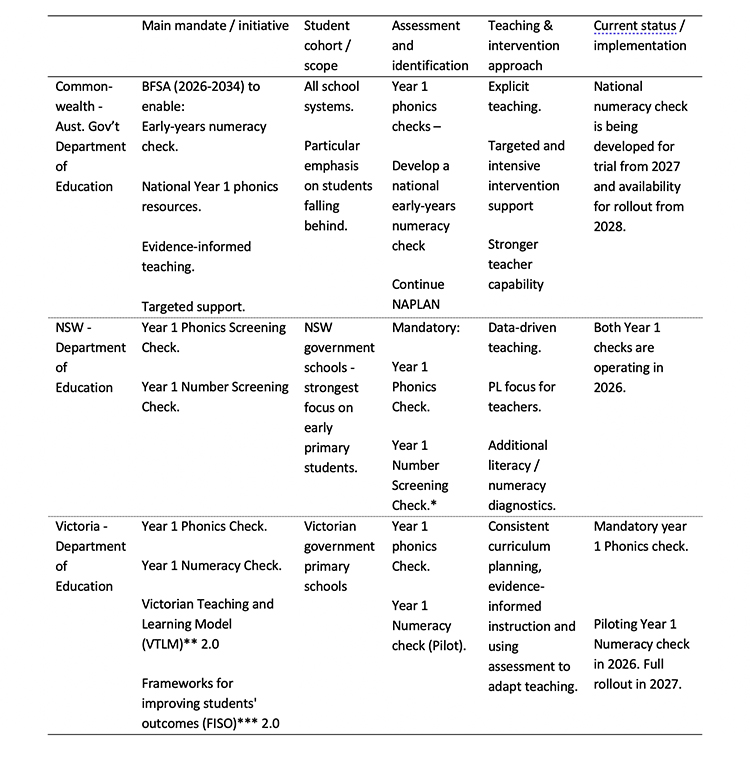
* Year 1 Number Screening check
** Victorian teaching and learning model
*** Frameworks for improving student outcomes
As shown in the table, assessment mandates are now required in Year 1 using specific screening tools for literacy and numeracy. These formative assessment tools are embedded, according to the initiatives, as an integral part of teaching and learning, not simply a test administered at a particular point in the year. This in turn, is a natural lead-in to data-driven decision making whereby teachers analyse student achievement data, not just to find out where students are performing, but to actively inform their practice.
It is apparent that literacy reform is more advanced than numeracy reform. The phonics check is now used in Australian government schools nationally, whereas early numeracy screening is still at different stages across jurisdictions. In recent years, various Australian states/territories have progressively adopted and adapted the Year 1 Phonics Screening Check, as it is known in the UK, which had its beginnings in 2010 as a stated intention of the UK Department for Education and became statutory for all Year 1 students in state-funded schools in England. The practice of using a universal numeracy screener is less widespread at this stage both nationally and internationally.
Our hope, of course, is that NAPLAN data will not stay as persistently stagnant as we have seen in recent years, with too many students below proficiency in literacy and numeracy. We are buoyed by the fact that the policy reform agenda, in principle, is driving system capacity and accountability and privileging (i) the use of evidence-informed pedagogy to enhance the quality and consistency of classroom instruction, (ii) initiating universal screening structures for both literacy and numeracy, and (iii) valuing and delivering on targeted intervention before learning gaps become entrenched.
All being well with a considered and supported approach to implementation quality and accountability, our ideal vision is that we will all be hearing less about new initiatives (circa 2026), and more about impact over the coming years. While implementation of any new initiative is a complex process that must be carefully managed, stagnant performance of our students, with the “one-in-three” students falling below proficiency levels makes the current reform agenda particularly significant.
Footnotes
1 The four NAPLAN proficiency levels are: Exceeding, Strong, Developing and Needs Additional Support. Students scoring at Developing or Needs Additional Support are considered not at expected “proficiency” levels. Developing is defined as “The student works toward expectations and may need some extra help”, while Needs additional support refers to students who requires targeted assistance to reach expected learning outcomes.
2 Noting that in 2023, the new four NAPLAN proficiency levels replaced a former system of bands so comparisons before 2023 are not straightforward.