


Fostering the Next Generation of Innovators
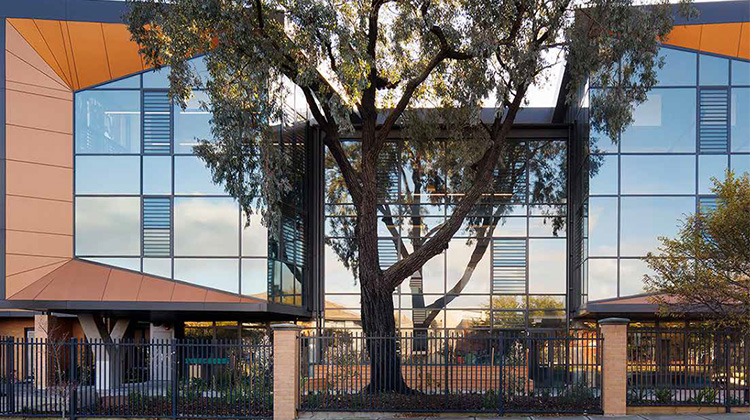
Kilvington Grammar School's award-winning new STEM and Library Centre is anchored by a mature Eucalyptus tree and conceived as a living laboratory, placing sustainability,
wellbeing and innovation at the heart of learning.
Designed by ClarkeHopkinsClarke Architects, The Hive was recently named Overall Winner at Learning Environments Victoria and Tasmania's 2025 Awards. It also won the Award for New Building/s or Facilities - Small.
The project transformed an ageing single-storey library into three levels of flexible spaces that support varied teaching approaches and group sizes and encourage collaboration, creativity and independent learning.
“Sustainable features such as solar panels, rainwater harvesting and exposed building services make the building itself a hands on learning tool, allowing students to engage directly with environmental initiatives,” says CHC Education Partner Stephanie Wan. “By integrating nature, technology and pedagogy, The Hive shows how thoughtfully designed spaces can inspire, connect and empower the next generation of learners.”
The project aimed to consolidate the school’s science and technology spaces, enhance cross-disciplinary collaboration, support future-focused teaching, enable curriculum growth, enhance street presence and reflect the school’s commitment to innovation, excellence and sustainability.
CHC's design response creates a future-focused, integrated STEM and Library Centre by uniting science, technology and library functions in one adaptable facility, according to Partner Simon Le Nepveu. “Spatial planning reflects Kilvington’s teaching and learning objectives,” he says. “Collaboration zones are positioned between specialist spaces, a central tiered forum, and strategic sightlines enabling passive supervision, cross-disciplinary exchange and student agency.”
Design supports multiple ways of working. Loose furniture allows specialist spaces to be reconfigured for different modalities. Two large laboratories support a variety
of learning opportunities, with continuous perimeter benches for both teacher-led demonstration and student-directed experimentation. Fabrication, media and VR-suites
support emerging technologies, while the ground-floor library functions as a campus wide resource.
A student-led briefing process went beyond conventional approaches, and centred students’ voices and ideas. Their priorities for sustainability and agency are embedded throughout, including panels sharing The Hive’s energy usage, and heat-reducing operable louvres to provide room-specific shading systems. Project Architect Anh-Tu Le says flexible collaboration spaces and glazed breakout rooms give students independence while remaining passively supervised. "Biophilic design creates calming spaces, enhancing natural indoor-outdoor flow, and supporting inclusion and wellbeing," she says.
Kilvington Grammar School's Head of Technology, Kirsty Watts, says the new building has introduced a seamless collaboration experience. “Students interact with
equipment and collaboration spaces with ease,” she says. Teachers report enhanced flexibility and collaboration in teaching and learning has increased both project-based and interdisciplinary learning
Director of Business Hirian Hinson says The Hive “has become a symbol of Kilvington’s forward-thinking ethos. We’ve achieved our vision for a collaborative, technology-rich environment that inspires curiosity and exploration."