


Actual Intelligence
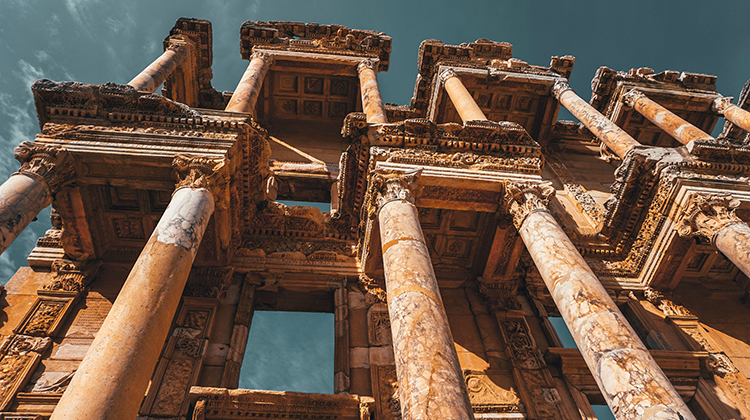
More than two thousand years ago, the citizens of ancient Ephesus created breathtaking works of art from marble. Visitors to this remarkable city in present-day Turkey can still admire the sculptures, but they are often equally amazed by something less celebrated: marble sidewalks and walls cut with delightful precision.
How did they accomplish this long before the invention of modern machinery?
The answer was surprisingly simple. Silk was dipped in olive oil and coated with sand. Working patiently together, two people pulled this primitive saw back and forth until solid marble slabs arrived. Silk provided the structure. Olive oil reduced friction. Sand supplied the abrasion. Masterpieces emerged through the combination of ordinary materials.
Education faces a huge challenge today.
Schools graduate many extraordinary young people every year. Yet educators everywhere wrestle with a persistent question: How do we preserve the curiosity, enthusiasm, and love of learning that children bring with them on their first day of school so all students excel?
Until we solve this challenge, isolated examples of excellence will continue to coexist with widespread disengagement. The goal is not simply to produce some successful graduates. The aim is to design learning environments in which every student flourishes.
Car taillights illustrate the premise of this article. The safety rules for automobile taillights are simple and enforced. Safety is the mantra. However, even with rules that must be followed, the creativity of auto manufactures for taillights is amazing. Safety and creativity co-exist. We need the same school design so that students learn while at the same time enjoying more creativity than ever seen is schools. Creativity partnered with learning must be the norm in every subject and not limited to the arts.
Fortunately, educators already possess the three essential intelligences for this dream education.
First is adult intelligence - building the structure that puts students on a successful year-long learning journey with an odometer. The second is adolescent intelligence - the creativity, energy, insight of children at all ages. The third is artificial intelligence - a tool capable of increasing efficiency, extending access to information, and answering many of the youthful “why” questions.
Individually, each intelligence has limitations. Together, they have the potential to transform education.
Just as the people of Ephesus combined silk, olive oil, and sand to shape enduring works from marble, today’s educators can intentionally combine adult, adolescent, and artificial intelligences to create something even more valuable: graduates equipped with actual intelligence - the knowledge, character, curiosity, and capability to thrive.
Our school staffs have the adult intelligence to beautifully organize the key concepts (no trivia) for every subject and every grade level and provide them for students the first week of each school year. Feed these lists into artificial intelligence asking for help to eliminate duplicates. Artificial intelligence is such a huge time saver here. The lists are analogous to road maps. Next adult intelligence creates the odometers so students know at any point during the year if they are on track to learn the year’s content, are speeding, are done for the year or in need of a different strategy for learning. Essentially, students are asked questions almost every week that are about randomly selected items from the key concept lists. (Multiple quizzes composed of questions about randomly selected key concepts are more accurate than one test of all key concepts.) Exams at the end of each quarter contain questions from complete year with 25% correct at end of first quarter is the expectation, 50% at semester, 75% at end of third quarter and 90-100% at year’s end. Students will ask if they get credit for answering more questions correctly than the expected percentage.
Equally important is the creation of dichotomous rubrics for guidance and evaluation of progress developing skills. Blank dichotomous rubrics are available for free at LearningThatLasts.com. They are a structure for yes/no questions as opposed to the common matrix rubrics. Because of the yes/no structure they are 3 to 4 times more accurate than the matrix rubrics.
The most exciting aspect of creating actual intelligence is adolescent intelligence. Because students have the key concepts and the rubrics, they have a wealth of ideas for learning the content. No two classrooms will be the same. Just like the journey from Brisbane to Adelaide, there are many route choices. Adolescents are not restricted by textbooks, lesson plans or pacing guides. They are not tied into sequence of learning nor how to best learn. Listen to their intelligence while at the same time keeping the taillight in mind. The odometer provides educators the same assurance as taillights do for the public. Safety is not compromised for taillight creativity, and learning is not compromised because of student creativity.
A major use of adult intelligence is establishing formulas for quizzes and exams. All assessments, except kindergarten, should have questions from prior grades levels and courses. Seventy percent from current course and thirty percent from prior courses is typical, but some schools select 50/50-half of the questions are from prior courses. Here is where artificial intelligence can shine. It makes it so easy for school systems to have content and sample questions from prior courses for teachers. Forgetting the content of a course soon after it is over does not create actual intelligence.
With both the key concept quizzes and the rubrics we add the points from every student to graph classroom totals. When students have personal bests or the classroom has an all-time best, we celebrate! With no celebrations we lose students; many become invisible. The key point here is that EVERY STUDENT CELEBRATES. All students have personal bests and all classrooms with an odometer moving together toward the destination will have scores higher than any previous time in the year. Celebrate. Students learn that the celebrations will not include food; they will be fun creating memories! Adolescent intelligence is amazing here. They think of the cleverest ways to celebrate at all grade levels. Sometimes the students provide different ideas, and dice are rolled to determine how to celebrate. A crazy way to celebrate is to sing songs with rounds and motions such as “A Sailor Went to Sea, Sea, Sea” or “Tooty Ta.” The first time the classroom has an All-time Best, students sing the song but stop with the first motion. Each additional time they succeed with a new score higher than ever before they add another motion but eventually run out of motions. Then adolescent intelligence creates more motions. Crazy. Is there a reason why academic celebrations should be less raucous than athletic celebrations?
Thus far we have used adult intelligence to design the system for learning that lasts and adolescent intelligence to help us deliver better learning. This is the silk and the olive oil. Now comes the sand of artificial intelligence. It can help adults organize, create dichotomous rubrics, suggest teaching strategies and assessment questions. Even more powerfully, artificial intelligence is best at making connections that further develop intrinsic motivation. Every key concept and every line on a dichotomous rubric have connections of interest that teachers would normally not think about.
Let’s take bronze for example. Artificial intelligence can tell us occupations with bronze, history, geography, science, literature, Bible references, art, music, theatre, algebra, geometry, and local locations to see examples of usage of the key concept or the skills described in the rubrics. Simple for artificial intelligence. Teachers will know the grade levels or prior courses where the key concept was taught and where the knowledge will be used in future courses. When isolated key concepts are connected to many topics of student interest the ever present “why” adolescent question goes a long way towards providing satisfactory answers.
Every profession distinguishes between design and delivery. Architects design and contractors build. Engineers design and factories manufacture. In education, however, we often devote enormous attention to delivery while giving far less consideration to design. When a new initiative fails, we blame the method, the technology, or the people implementing it. Rarely do we ask whether the design itself was flawed. Even though delivery is addressed under adolescent intelligence, the focus of this article is re-design of the education learning process.
The challenge before us is not to choose among the three intelligences. It is to combine them wisely.
When these three intelligences work together, they create something greater than the sum of their parts: actual intelligence.
Our biggest asset in schools is not money, time, technology, or even teacher expertise. It is the intrinsic motivation God gave children at birth, and they bring with them as they enter school - the wonder that causes them to ask questions, the resilience that compels them to keep trying, and the joy that accompanies discovery. It is easy to think we are losing intrinsic motivation in the middle grades. Actually, the loss starts in grade one with about 10% of students giving up on school learning already.
Guard intrinsic motivation very carefully and actual intelligence for all students will be in your future.
Contact Lyle “Lee” Jenkins [email protected] Web: https://learningthatlasts.com/
Look up Lyle Lee Jenkins on Amazon to search for his resources.