


A Young Australian in Washington D.C.
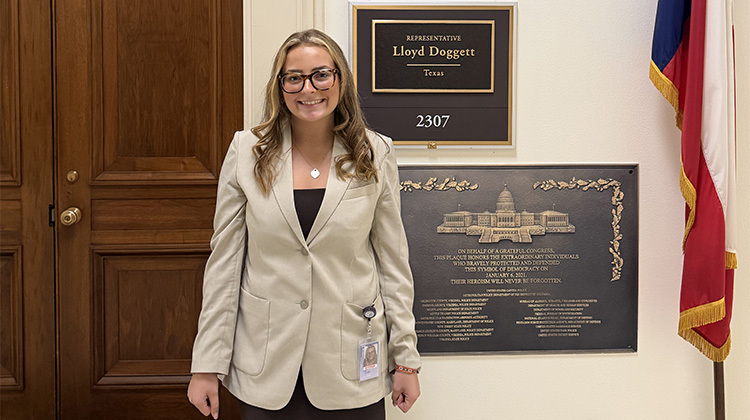
As the United Nations International Day of Women in Diplomacy on 24 June highlights the importance of women’s representation in global decision-making, young Australian Georgina Tenny has had a firsthand perspective on what diplomacy and power looks like in practice.
When Georgina stepped into Washington, D.C. earlier this year for a congressional internship in the United States House of Representatives, she expected to observe politics in action.
What she did not expect was how quickly the experience would shift the way she understands power itself.
A Loreto College Marryatville Old Scholar (2022) and Honours student in International Relations and Political Science at Flinders University, Georgina joined The Fund for American Studies program, with her Washington experience supported through the Jeff Bleich Centre at Flinders University. She split her time between academic study and the institutional heart of U.S. policymaking on Capitol Hill.
For Georgina, the contrast between theory and practice was immediate.
“Studying politics often focuses on systems and ideas,” she reflects. “But being inside government shows you how those systems actually operate, and how much of power is shaped by structure.”
That exposure reshaped how she thinks about democracy and leadership, particularly as a young woman navigating political environments where representation continues to evolve and influence is still unevenly distributed.
Moving between classroom learning and Capitol Hill, Georgina found herself constantly shifting between analysing governance and witnessing it in practice. That dual perspective made the relationship between freedom and power more tangible.
“What struck me most was how differently power can be experienced depending on who occupies the room,” she explains. “As a young woman in those spaces, you become very aware of representation and whose voices are still emerging.”
That awareness of representation also shaped how she viewed the structures underpinning political systems themselves.
Gender, she says, remains an important but evolving dimension of political life. While representation in diplomacy and policy environments has improved, influence is still unevenly distributed.
For Georgina, these lived observations became inseparable from broader questions about how institutions are designed, and how they distribute power in practice.
A key focus of her experience in Washington was observing how constitutional design influences political behaviour. In the United States, she notes, power is deliberately constrained through institutional checks and balances, including a strong separation of powers and judicial oversight.
These “constitutional constraints”, as they are often described in political theory, became more than abstract concepts during her time in the U.S. They were visible in real-time decision-making, legal interpretation and the everyday functioning of government.
Georgina recalls attending discussions through her program that explored the foundations of American constitutional governance, where a recurring theme was the importance of designing systems that actively constrain power.
One idea from American constitutional thought stayed with her: that liberty depends less on electoral participation alone, and more on the institutional structures that safeguard it over time.
“Freedom depends on more than who holds power at any given time,” she says. “It depends on how that power is designed, distributed and constrained.”
That distinction, she suggests, is often less visible in Australian public debate, where attention tends to focus on political actors rather than institutional design.
“Coming from Australia, there’s a tendency to assume stability is natural,” she reflects. “But what I saw in Washington is that democratic systems require constant maintenance, especially when it comes to limiting power.”
In contrast to the United States, she notes, Australia’s system relies more heavily on conventions and statutory protections, raising important questions about how power is constrained in practice.
“These comparisons are less about ranking systems and more about understanding how democratic institutions function beneath the surface,” she says.
“Democracy alone doesn’t guarantee liberty,” she reflects. “It’s the structure around it, the rules, limits and accountability mechanisms. that determine how stable that freedom actually is.”
She also notes that some of these reflections were developed and previously published through Doctors of Democracy, alongside her academic and practical experience in Washington.
Georgina adds that these questions are particularly significant for women entering political and diplomatic spaces, where representation and influence do not always progress at the same pace.
As she returns to Australia, Georgina brings with her a renewed focus on how institutional design shapes opportunity, accountability and voice.
Her experience has also reinforced the importance of international exposure for emerging leaders, particularly those seeking to understand global systems from the inside.
Looking ahead, she hopes to continue exploring the intersection of international relations, governance and public policy, with a particular interest in how institutional structures shape democratic outcomes.